


Scroll through YouTube or Instagram long enough, and you’ll see countless gurus claiming that dropshipping with Meesho is the easiest path to wealth in India. They show off flashy dashboards with claims of turning a ₹5,000 ad budget into lakhs in revenue overnight.
But as anyone with real e-commerce experience knows, if it sounds too good to be true, it usually is.
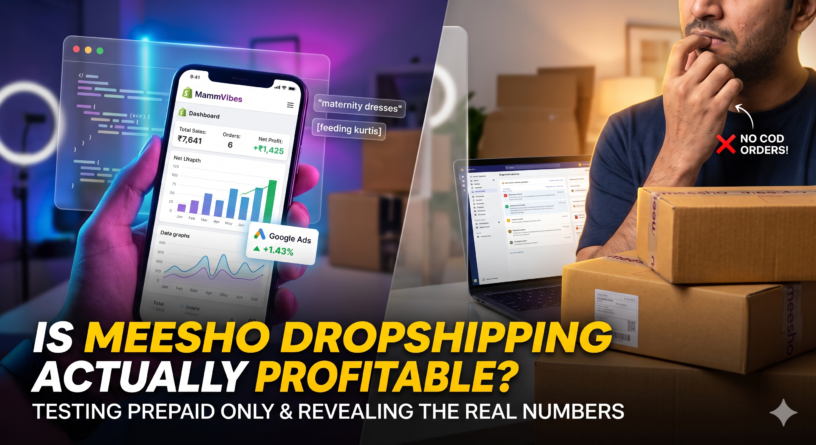
To peel back the curtain, digital marketer Shivansh B. put this exact model to the test. He ran a transparent, ground-up 24-hour experiment building a Meesho dropshipping store. To eliminate the biggest headache in Indian e-commerce—Return to Origin (RTO) from failed cash-on-delivery deliveries—he made one bold rule: Prepaid orders only.
Here is the exact step-by-step breakdown of how the experiment went, the numbers behind it, and whether Meesho dropshipping is actually worth your time.
The 5-Step Game Plan
Building a business from scratch and pulling sales within 24 hours requires a hyper-focused workflow. The challenge was split into five distinct phases:
- Product & Niche Research: Identifying a low-competition, high-demand product.
- Supplier Verification: Checking Meesho for availability, reviews, and pricing margins.
- Store Creation: Setting up a sleek, high-converting storefront.
- Ad Launch: Running parallel campaigns on Meta (Facebook/Instagram) and Google Search.
- Fulfillment & Math: Reviewing the raw expenses versus revenue to find the net profit.
Phase 1: Finding a Hidden Niche
Most beginner dropshippers make the mistake of selling generic products like viral sunset lamps or neck fans. To stand out, the experiment utilized an organic research method: scrolling a fresh Instagram account trained specifically to engage with product ads and reels.
The winner? Maternity dresses and feeding kurti’s.
Market Context: Over 3 crore women become mothers every year in India. AI-driven market research reveals that the maternity clothing niche is significantly less competitive than standard fashion apparel, leaving a healthy gap for custom brands.
Phase 2: Building the Infrastructure
Once the products were short-listed on Meesho based on high star ratings and positive customer reviews, it was time to build the digital infrastructure.
Instead of building a messy, amateur site, the process focused on building brand trust:
- The Domain: Registered a professional domain (
mammvibes.in) via Hostinger. - The Trust Factor: Set up a dedicated professional email backend (
help@mammvibes.in) rather than using a generic Gmail account. - The Layout: Built the storefront on Shopify using a specialized page-builder app (GP Pages) to craft a highly optimized mobile layout.
- The Payment Gateway: Integrated PhonePe PG to smoothly process incoming UPI and card payments since cash-on-delivery (COD) was disabled.
Phase 3: The Ad Strategy (Meta vs. Google)
With a ₹7,000 combined daily budget, ads were deployed across two separate networks to see which platform would bite first on a prepaid-only offer.
Meta Ads Setup
- Budget: ₹4,500/day
- Targeting: Women aged 20–40 living in major tier-1 and tier-2 Indian cities.
- Creatives: Static single-image and carousel ads.
Google Search Ads Setup
- Budget: ₹2,500/day
- Strategy: High-intent phrase match (
"maternity dresses online") and exact match ([best feeding kurtis]) keywords. - Tracking: Integrated the Shopify Google & YouTube app to automate conversion tags flawlessly.
The 24-Hour Results: Breaking Down the Revenue
After a grueling day of building, tweaking, and waiting, the Shopify dashboard was opened.
The store generated 6 genuine, paid transactions (ignoring internal gateway test orders) totaling ₹7,641.50 in gross revenue. For a brand-new storefront operating strictly on prepaid orders, pulling over ₹7,500 in 24 hours is highly impressive.
But gross revenue is a vanity metric. Let’s look at where the budget actually went.
The Profit & Loss Sheet
| Expense Item | Cost (INR) |
| Gross Revenue | + ₹7,641.50 |
| Hostinger Domain Registration | – ₹647.82 |
| Meta Ad Spend | – ₹897.65 |
| Google Ad Spend | – ₹2,516.00 |
| Meesho Product Sourcing Cost | – ₹2,155.00 |
| Total Expenses | – ₹6,216.47 |
| Net Profit | + ₹1,425.03 |
The Advertising Plot Twist
The data revealed a massive contrast between the two ad platforms:
- Meta Ads was a total bust. It spent nearly ₹900 and generated exactly zero sales. Relying purely on static images in a highly visual fashion niche was a rookie mistake; apparel requires video ads to convert on social media.
- Google Ads carried the entire experiment. It drove 67 highly targeted clicks at an average Cost-Per-Click (CPC) of roughly ₹37, resulting in all 6 purchases. Because users typing “maternity dresses” into Google already have their wallets out, they were happy to pay upfront.
The Reality Check: The Cons of Using Meesho
While a net profit of over ₹1,400 in a single day proves the concept works, the experiment highlighted serious long-term bottlenecks with Meesho as a permanent supplier.
- The Delivery Identity Crisis: When a logistics partner calls your customer to deliver the package, they don’t say, “Your MammVibes order is here.” They say, “Your Meesho courier has arrived.” This shatters the illusion of an independent boutique and can harm customer retention.
- The COD vs. RTO Dilemma: Turning on cash-on-delivery would scale order volume exponentially in India, but Meesho’s systems frequently auto-reject dropshipped COD orders. Even if they clear, high RTO percentages can quickly wipe out slim margins.
- Shipping Delays: Sourcing directly through the standard Meesho app means shipping times hover between 5 to 7 days, which is slow compared to modern e-commerce expectations.
The Verdict
Is Meesho dropshipping a viable business model? Yes, as a sandbox.
It is a fantastic, low-risk playground to test product ideas, learn how to build high-converting landing pages, and master paid traffic without sinking thousands into bulk inventory upfront.
However, it is not a sustainable way to scale an empire. The smart play is to use platforms like Meesho to validate demand. Once a specific product begins generating consistent daily sales, pivot immediately: buy inventory in bulk, handle fulfillment through reliable private logistics providers, and build a genuine, customer-centric brand you fully control.

Leave a Reply